
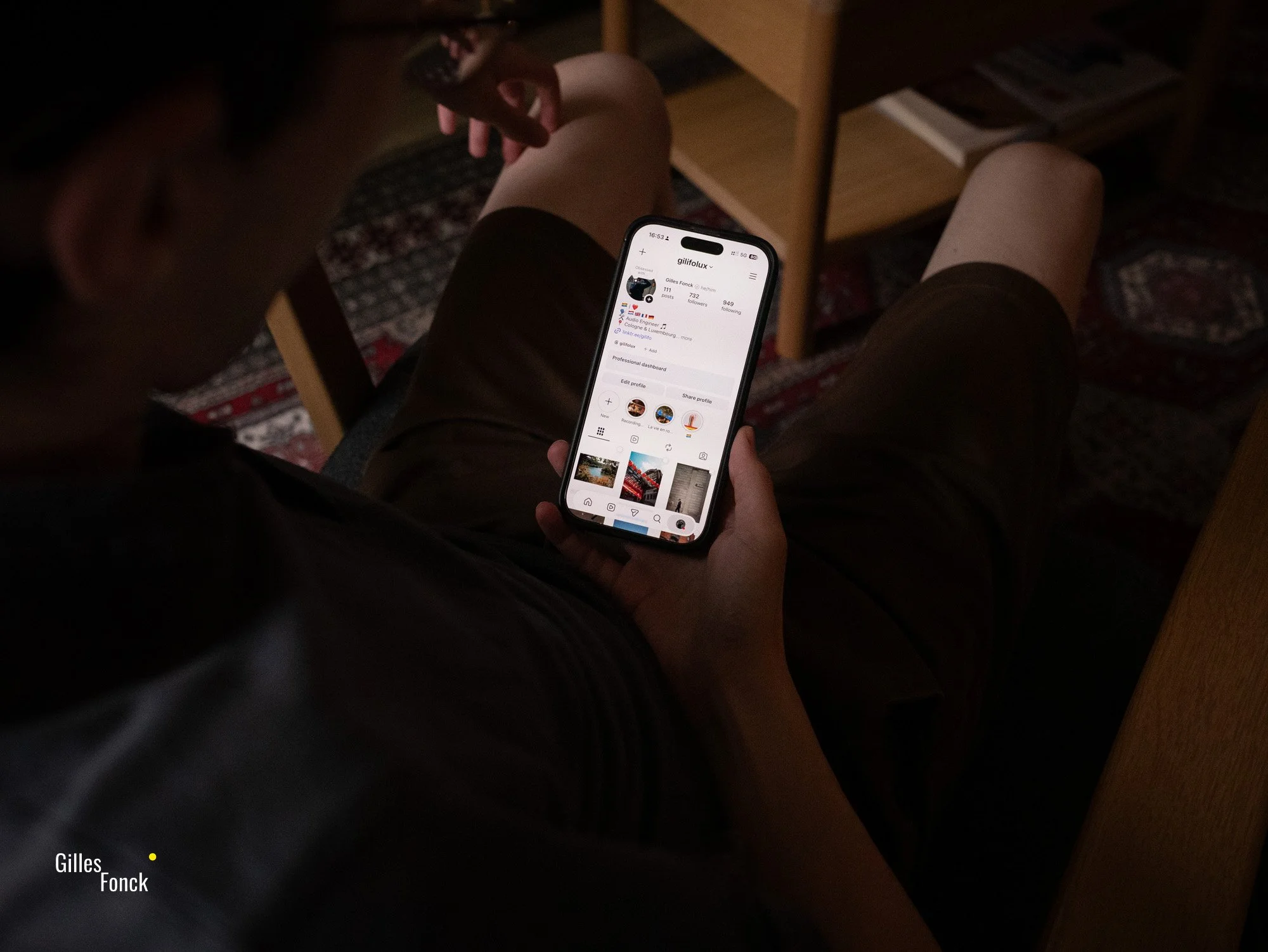
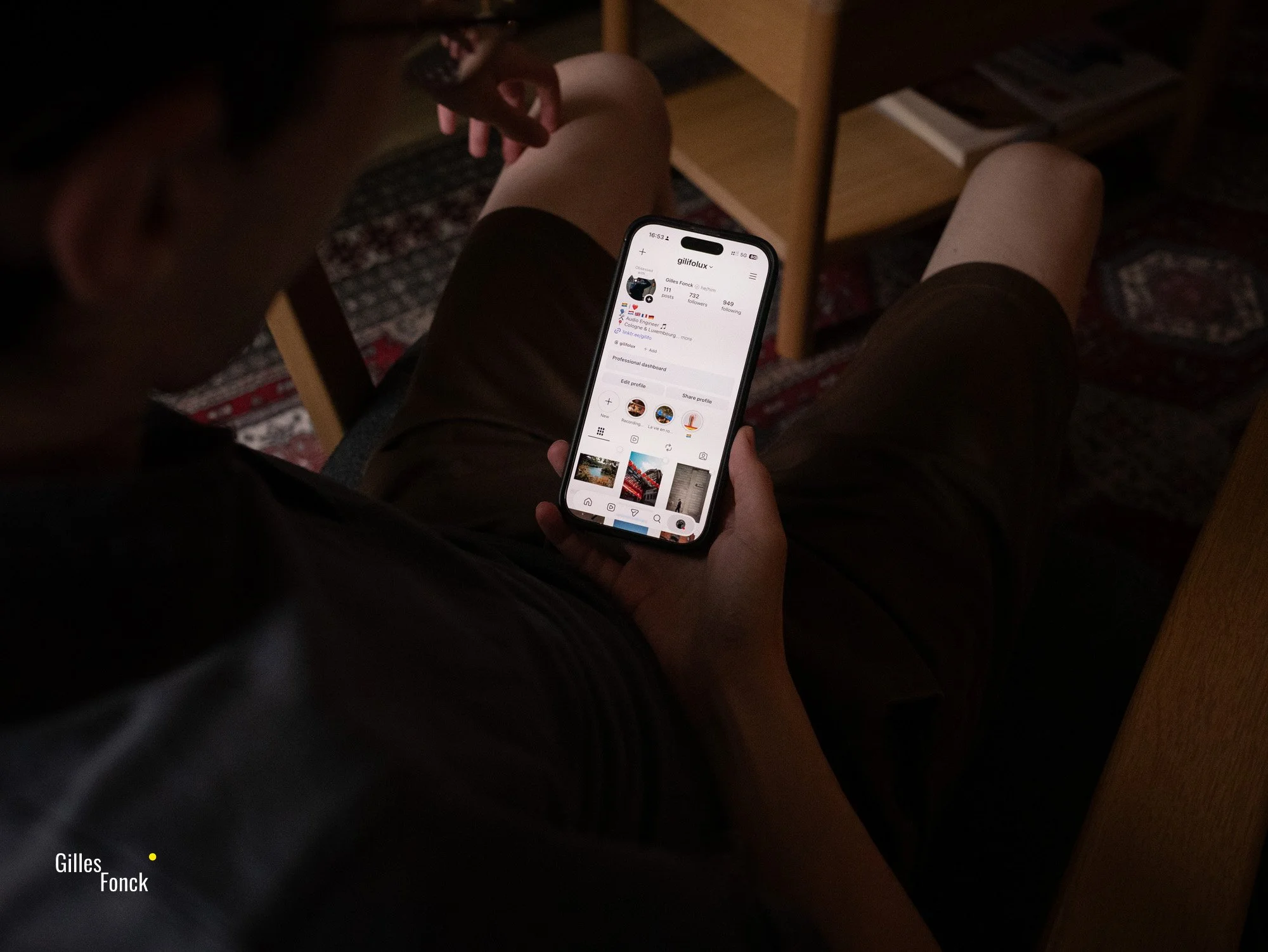
You've got Instagram: Why do you need a website?
I just pressed “publish” on my website. But why, in 2026, would I need a website at all? After all, we’re all on social media!
Discover my thoughts and ideas around social media and art online in this, my very first, blog post.
In the early days of the internet, a website was vital for any creative person wanting to present their work online. Social media really did not have the tools do accomplish that: Facebook mostly was a way to keep in touch with relatives and friends, Instagram wasn't really a thing yet and Twitter (now X) was very much focused on short-form text. But a few years have passed since, new platforms have risen, old ones have transformed and most importantly, everybody and their dog now has their own profile on one of those apps. As a consequence, more and more artists now don't have a website and have shifted to presenting their work solely on Instagram, TikTok and co.
So why would a musician and photographer like me choose to go through the hassle to publish a website in the year 2026?
The different facets of human art
Human nature is multifaceted and versatile, and thus, art created by humans is too. Some artists might pick one discipline and explore all of it's aspects and faces while others will choose to work as multidisciplinary artists. The latter kind seems to have gained in popularity with modern technology making it easy and relatively affordable to explore different forms of art. This facilitates and expands an evolution with foundations in the Renaissance ideal of the Uomo Universale, the universal human being, and popularised by the Bauhaus at the dawn of the 20th century.
While art might be multidisciplinary, social media, however, often is not. Platforms like TikTok and Instagram rely heavily on visual content like pictures and videos, leaving little space for forms of art relying on sound or literature. These forms of art are often relegated to other platforms more adapted to their needs like music streaming platforms or (e-)book-stores and libraries with social media solely being used as a promotional platform.
This segmentation of content makes it hard for multidisciplinary artists to present their body of work as a whole. A website on the other hand is able to incorporate different forms of media, embeds and links and present the entirety of an artists creations.
With this in mind, it might seem counterintuitive of me to keep my photography and music on two separate pages within my website. However, both benefit from being just a click away from one another and being presented in a consistent, recognisable design language. Moreover, the blog section of my website allows me to express and explain my thoughts, ideas and processes. The articles published here may even relate to music or photography at all! A website gives me freedom to express the different facets of myself at my own discretion.
Design and presentation
While most social media platforms and apps nowadays do have a pretty neat design, they never give an artist full creative control over how their work is presented to the public.
Apps like Instagram or TikTok cater to a multitude of different kinds of contents and thus provide a standardised solution to post photos, graphic work, videos and text. While this does make it easy for anyone to upload content and spread their art, it also makes everybody's posts look similar and might not be the best way to view an artist's specific work.
Of course, there are creative ways to use these standardised spaces as a canvas and make your posts stand out. You might create negative space around your photos, get funky with the distribution of content in a carousel or post your music with a highly entertaining video (e.g. a cute cat). But all of those applaudable efforts still live in the confines the app gives you. It will still be the same 9:16 aspect ratio of a TikTok or the 4:5 format of an Instagram post. And there will still be the logo of the platform, the buttons to like, repost and comment as well as an area to put an ever so clever caption.
However, when hosting your content on your own website, you get almost complete freedom to present your work like you intend it to be viewed! From incorporating your own design language and guidelines like typography, logos and color palettes to the placement of content and the flow between different creations, every aspect of your website is under your control.
This too has its limitations, as modern, responsive web-design demands you work in a grid in order to adapt to different screen sizes. And sometimes, you might need to deal with some tradeoffs in the details to make your site translate well between computers, tablets and mobile phones.
But even with these tradeoffs taken into account, you still have much more control over the design and presentation of your artwork on your website than on any social media platform.
A website as a creative endeavour
If you have a passion for visual arts and design, making a website is a creative endeavour in itself. For me personally, the idea of my own website got me started on thinking of developing a visual identity for myself as an artist for the first time. I ended up developing a full brand guideline including a logo suite, a color palette, typography and even a set of rules for tone of voice and the general style of communication.
While social media platforms allow for some customisation of your visual identity, it often does not go far beyond a custom profile image and a banner as well as integrating your guidelines in your own content. As discussed before, a website remains far more flexible and ensures a consistent identity across different sites and topics.
But even if setting up a website isn't any fun to you, choosing and curating the work you intend to publish on your site can be a great way to reflect your own creativity and look back at what you've already achieved. While social media focuses on quantity, a creative website often benefits from a certain restraint. You want to choose works of art, that best show your style, your intent and your artistic evolution over the years. On Instagram, we rarely look back at posts we already published, and when we do, we often obsess over engagement metrics, like numbers and comments. Choosing the photos I published as a first batch made me look back through my entire catalogue. This process made me see new series, rate old pictures with my since-evolved experience and realise how many (good) photos I have taken over the years.
Independence
Remember when a certain American tech billionaire acquired a certain social media platform beloved by millions and turned it into one of the most prominent hubs for misinformation and hate speech? The case of X (formerly known as Twitter) is a textbook example why relying heavily on a monopolised social media platform in order to present your work might end up being a bad idea. But a service being flipped by an acquisition or new operational staff is not the only risk creatives face on social media.
While in the early days, your feed on Facebook or Instagram might have been roughly chronological (I can remember scrolling to the end of it in less than half an hour), it is now entirely run by algorithms. These are programmed to work out what kind of content is most likely to keep you on the app in question and fill your feed with it exclusively. While this has its own social, medical and political challenges which go far beyond the subject of this article, it also means that your art unwillingly entered a competition. And this competition is not only among artists, but among all the content available on that platform! Your direct rivals might suddenly be auntie Cath's apple crumble, the aforementioned CCC (cute cat content) and the newest questionable social media trend. (To be fair, who can resist a cute cat promoting an apple crumble with a TikTok-dance?)
This leads to a lot of artists understandably trying to shoehorn their art into formats the algorithm tends to favour by adapting it to the latest "trending sound", adding their music to some engaging video content or posting still images as videos (which I've definitely been guilty of). Even worse, we start taking inspiration from popular content and try our best to recreate it. But is that really creativity or are we rather starting to chase a trend for the sake of engagement?
The entire concept reminds me of concealing your dog's medication in their food so they will take it. And just like you should be taking medication regularly, you have to keep engagement high and post frequently if you want to stand a chance in the heated rivalry around the algorithm's and thus the user's attention.
Other big risks linked to algorithms are practices such as shadow-banning (limiting the reach of an account, often for arbitrary reasons), structurally engineered feedback loops (social media bubbles), addiction and ongoing polarisation. If you want to reed up on those, there are articles by people far more qualified than me, with research to back it up. I will be linking some resources at the end of this page.
Warning
If you think you might be suffering from social media addiction or any other adverse, health-related effects, please seek professional help. For example, you can read up on the topic at helpguide.org.
Considering these darker sides of social media, it might be best to have an independent place to host your art, either as a main homepage for your artistic endeavours, or as a fallback in case things on your social media platform of choice start going south.
On a website, the viewer isn't relying on an algorithm to curate their feed, they can consume your work with intention. They decide how long they stay, what pictures to contemplate, which links to follow and which articles they read. And all of this, with much less chance of being affected by those aforementioned negative effects.
Certainly, the internet nowadays is run by big corporations and if you are like me and don't want to learn putting together a secure and modern website including content management from scratch, you will often end up using a commercial tool, hosted by some sort of tech company. (E.g.: This website was created and hosted on Squarespace, an American tech corporation employing roughly 1.700 people and making over 1 billion USD in revenue in 2023.) But at least, it frees your art from the clutches of social media platforms and their algorithms.
While social media can be great to share your work and certainly has its advantages when it comes to promoting an artist's work, there also are some pitfalls which call for an alternative solution to present artistic creations. Cohesive presentation of multidisciplinary bodies of art and control over the design and presentation are difficult to do on social media sites. Moreover, creating a website can itself be a creative endeavour and curating a portfolio is a great occasion to reflect on past work. Finally, a website creates a degree of independence social media fails to give to artists and creatives.
For the moment, I will of course be continuing to use social media, primarily Instagram and YouTube, both for consuming and for publishing content. There will certainly also be some content exclusively on those pages, as I intend to keep my portfolio on here more intentional and minimal. But it's certainly beneficial to head over to this site from time to time to see what I have been up to recently and read some more blog posts and articles.
Selection of resources concerning social media and its adverse effects:
American Psychological Association, Social media and the internet.
Center for Countering Digital Hate, What are algorithms and how do they make social media more harmful?.
Center for Humane Technology, Social Media in Society.